I'm on the second draft of a novel, which means most mornings I spend some time arguing with a machine about a sentence.
It goes well, at first. I paste in a chapter, we work a paragraph, and for that opening stretch the thing sounds like me. Clipped where I'm clipped. Willing to leave a gap where I'd leave a gap. Good company.
Then somewhere around the fortieth exchange, with no announcement, it hands back a line about how the harbor held a tapestry of longing.
Nothing had changed. Same chat, same model, same file, same person typing. But the voice had wandered off somewhere while I wasn't watching, and I'd been nodding along to it for a while before I looked up.
There's a word people reach for when this happens. They say it drifted.
What is context drift?
Context drift is when an AI's working picture of you erodes over a session or between sessions, so its output slides away from your instructions, your voice, and your situation. Nothing errors. Nothing refuses. The answers just get gradually less yours.
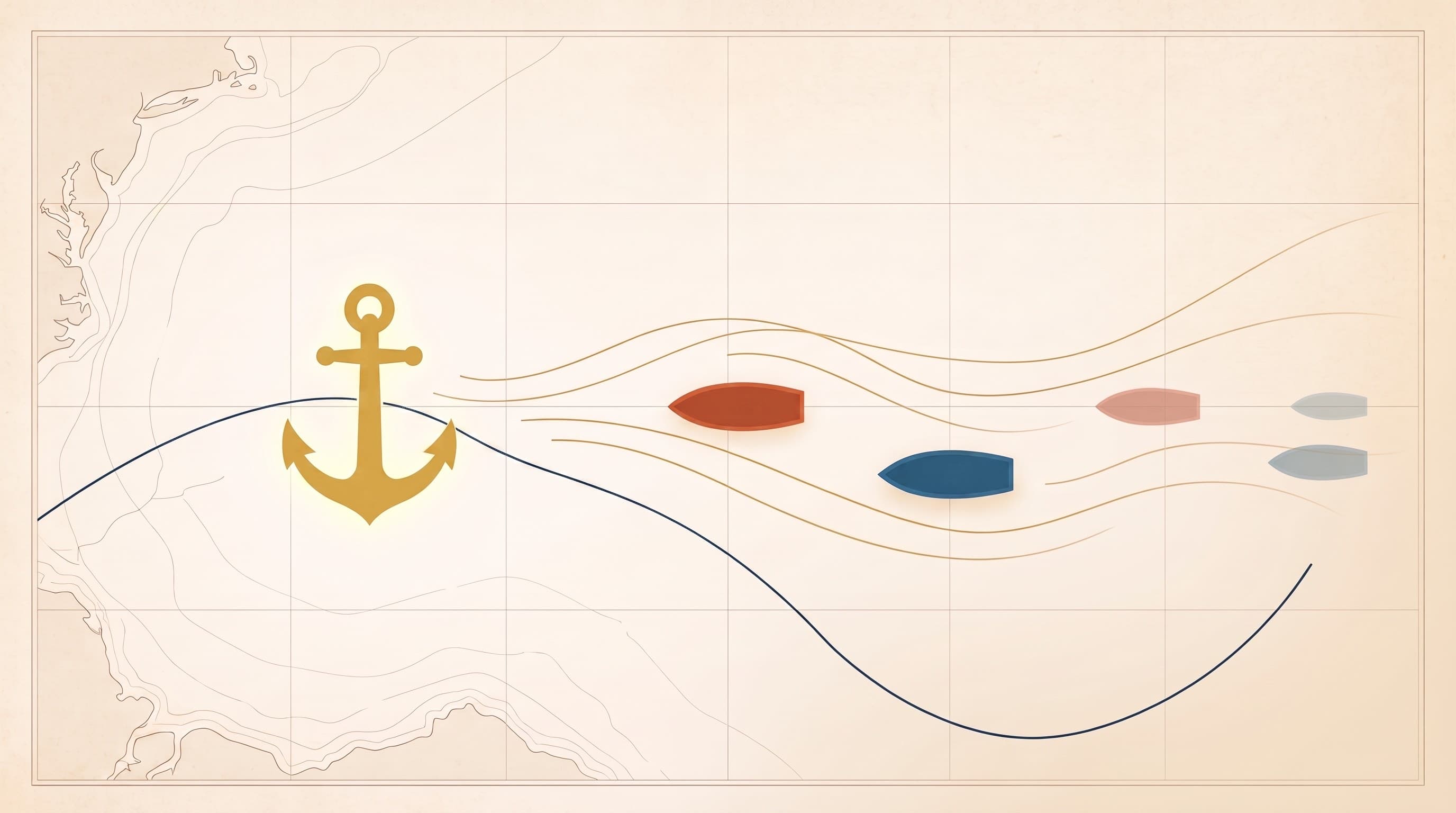
The word is borrowed from navigation, and it's borrowed accurately. Drift is what a vessel does when nothing is holding it. No storm required. The current moves, the hull goes along with it, and the boat that sat on station at noon is a half mile downriver by dinner without one dramatic moment in between.
That's the part people miss about their AI. They're waiting for a failure. Drift doesn't fail. It just relocates you, politely, while you're busy.
This isn't the drift your engineer friend means
Worth clearing up early, because the term is crowded.
In machine learning operations, model drift and data drift describe a deployed model going stale as real-world inputs move away from what it trained on. It's a monitoring problem. You watch it with dashboards, you retrain, you ship a new version. Real thing, useful discipline — just not what's happening to you.
What's happening to you happens in one afternoon, in one window, with a model that hasn't changed at all. Same weights, same version. The only thing that eroded was what it knew about you.
What drift actually feels like
You'll recognize at least two of these.
- Instruction Drift
- It ignores a rule you set twenty messages agoYour directions are still in the window, buried under everything that came after
- Voice Drift
- It stops sounding like youNothing ever defined your voice, so it settles toward the average of everything it read
- Situation Drift
- It gives good advice for somebody else’s lifeIt’s reasoning from circumstances of yours that expired
- Session Drift
- It contradicts what it told you last weekNothing carried over. Every conversation started from zero
Four different symptoms, one shared cause: at no point did the model have a stable picture of you it could return to.
Why it happens
Three reasons, and they stack.
There was never a fixed reference. Most people start from a blank chat and describe themselves in fragments, mid-task, when it's already relevant. The model assembles a rough sketch out of whatever leaked into the conversation, and a sketch is exactly the kind of thing that erodes.
Whatever you did give it gets buried. Custom instructions load once, at the top. Then the conversation piles on. Recent turns pull hardest, so by message fifty your careful setup is competing with forty-nine things that arrived more recently and shout louder. This is why writing a longer instruction block rarely helps. The problem is position, not volume.
Nothing survives the session. Close the tab and the working picture evaporates. Tool memory catches some fragments, but it stays locked inside that one tool and holds onto things that stopped being true months ago. That's the sibling problem to this one: drift is the slide inside a session, and starting from zero is what happens the moment you open a new one.
What an anchor does about it
A context anchor is a short, durable document holding one stable part of you: your values, your voice, your current situation. You write it once and reuse it everywhere.
Against drift it does something specific. It gives the model a position to return to.
That's the whole mechanism, and it's less magical than it sounds. When the voice starts flattening in hour two, I paste my writing codex back into the conversation. Ten seconds. The tapestry-of-longing sentences stop, and we go back to work. I didn't restart the chat or write a better prompt. I re-anchored.
The same move works across tools, which is the part tool-native memory can't match. My anchors open in Claude, in ChatGPT, in whatever I wire up next month. Compared against the alternatives, that portability is most of the value.
And for voice specifically, having it written down is the difference between a model guessing at how you sound and a model checking against a real reference. Guessing produces the average. The average is smooth, hedged, and faintly promotional — exactly what showed up in my harbor.
What an anchor won't do
Here's where I'd rather be honest than impressive.
An anchor will not stop a very long conversation from degrading. Attention thins out over huge inputs, and no document you paste in changes that. It will not protect you from a model being updated underneath you — that happens without warning and can shift tone overnight. It will not make a model that never knew a fact suddenly know it. And it will not save you from an anchor that quietly went out of date, because a stale file never drifts at all. It's wrong from the first message, confidently, in your own words.
What it does is narrower and more useful than any of that. It gives you a reference you can return to in seconds, so drift becomes something you correct mid-session instead of something you discover in work you already published.
An anchor doesn't stop the current. It keeps you where you meant to be.
Any vessel at anchor still moves. It swings with the tide, it rides the chop, it isn't nailed down. But it's there in the morning, in the place you chose, which is the entire point of dropping one.
Where to start
Pick the drift that's bothering you most and write the reference for that one thing.
If the voice keeps flattening, write down how you actually sound. If the advice keeps missing your real life, write down where you're standing right now. If it can't hold your values from one week to the next, start with a Personal Constitution, which is free and takes about half an hour.
Don't write all of them today. One is enough to feel the difference, and if the blank page is the obstacle, that's what context mining exists for. The questions do the digging.
I still argue with a machine about sentences most mornings. It still drifts. The difference now is that I catch it around message twelve instead of somewhere past forty, and fixing it costs me a paste rather than an afternoon.
The harbor stayed a harbor. Nobody has mentioned a tapestry since.
Frequently Asked Questions
- What is context drift?
- Context drift is when an AI's working picture of you erodes over a long session or between sessions, so its output slides away from your instructions, your voice, and your situation. Nothing errors and nothing refuses. The answers just get gradually less yours until you notice the thing sounds like a stranger.
- Why does ChatGPT stop following my custom instructions?
- Usually because your instructions are competing with everything that came after them. Custom instructions load once at the top, then forty messages of conversation pile on top, and the most recent turns pull hardest. The fix is repetition of a stable reference, not a longer instruction block.
- Is AI drift the same as model drift?
- No. Model drift and data drift are MLOps terms for a deployed model degrading as real-world inputs shift away from its training data. That's a monitoring problem for engineers. Context drift happens to you inside a single chat window, in one afternoon, with a model that hasn't changed at all.
- Why does AI stop sounding like me?
- Because nothing ever told it what you sound like. Absent a definition of your voice, a model regresses toward the average of everything it read, which is smooth, hedged, and faintly promotional. Give it a written voice reference and it has something specific to return to.
- Can you prevent AI drift completely?
- No, and anyone promising that is selling something. Long conversations degrade, models get updated underneath you, and attention thins out over very long inputs. What you can do is give the model a fixed reference it can return to, so drift is something you correct in seconds instead of something you discover in your published work.